
Nov 19, 2026
These 7 Retirement Planning Mistakes Could Leave You Financially Unprepared Later
- Sarah Nelson

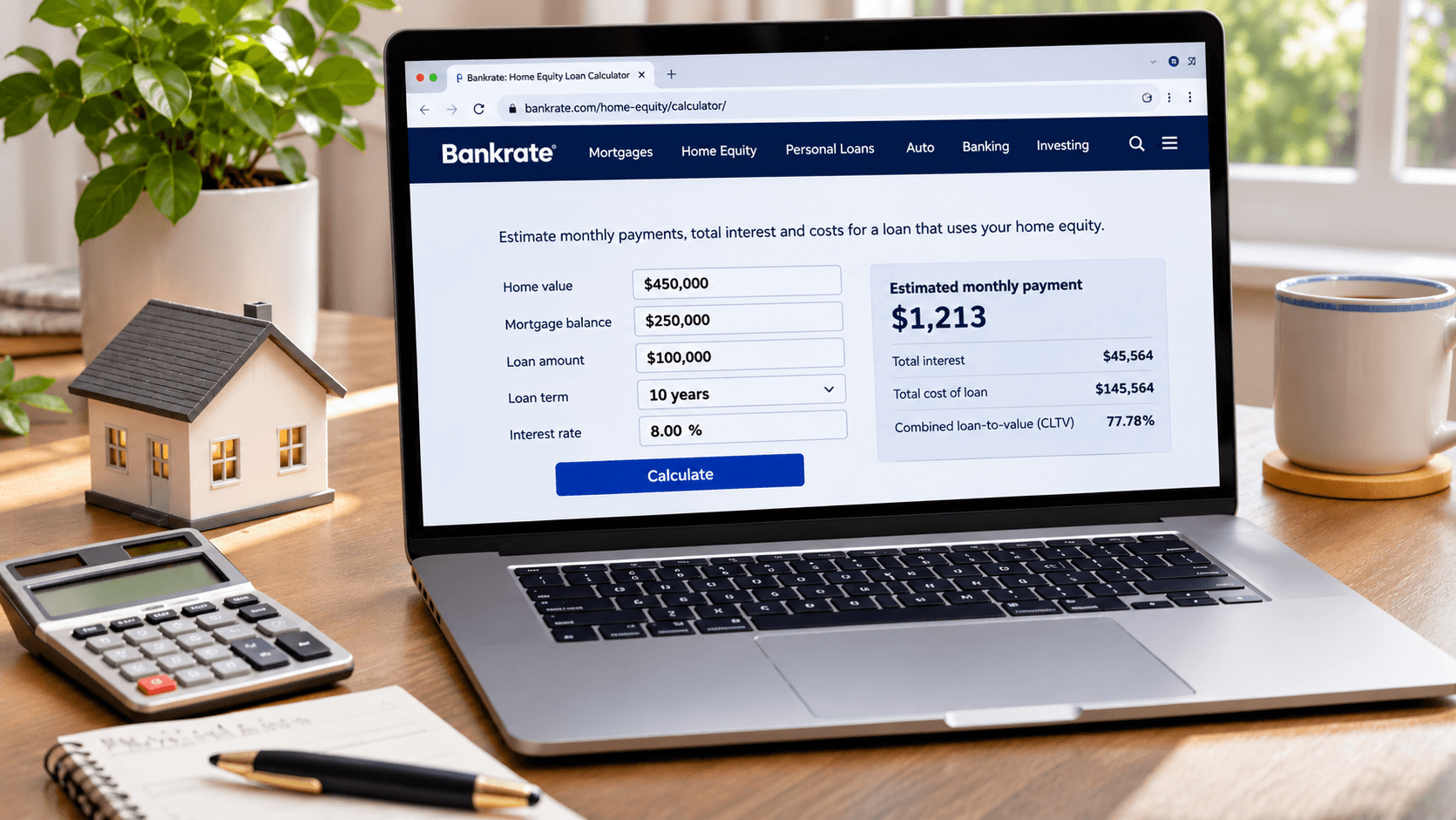
How Home Equity Loan Calculators Help Estimate Monthly Borrowing Costs
Homeowners who need funds for major expenses may look into borrowing against the value of their property. The Bankrate Home Equity Loan Calculator can serve as a starting point for estimating potential borrowing amounts, monthly payments, and financing costs.
Before applying for a loan, understanding how home equity works may help homeowners make informed financial decisions. Loan amounts, interest rates, repayment periods, and existing mortgage balances can all influence affordability.
Using a home equity calculator may help borrowers compare different borrowing scenarios, evaluate their budgets, and identify potential financial obligations before committing to a loan.
The Bankrate Home Equity Loan Calculator is an online financial planning tool associated with estimating borrowing costs against home equity. Depending on the calculator selected, users may be able to estimate available equity, potential loan payments, or repayment costs.
Home equity represents the difference between a property’s estimated market value and the outstanding mortgage debt secured by that property.
For example, a homeowner with a property valued at $400,000 and an outstanding mortgage balance of $250,000 would have approximately $150,000 in home equity.
However, this amount does not necessarily represent the total amount available for borrowing. Lenders generally evaluate factors such as credit history, income, existing debt, property valuation, and combined loan-to-value limits.
A home equity loan calculator uses financial information to estimate potential borrowing scenarios.
Users may need to provide the following details:
The calculator uses the applicable inputs to generate estimates. Results may vary depending on the calculation method and assumptions.
| Financial information | Example amount |
|---|---|
| Estimated home value | $400,000 |
| Outstanding mortgage balance | $250,000 |
| Current home equity | $150,000 |
| Assumed maximum combined loan-to-value ratio | 80% |
| Estimated additional borrowing capacity | $70,000 |
In this example, the homeowner has $150,000 in equity, although the estimated additional borrowing capacity is $70,000 under the assumed 80% combined loan-to-value limit.
Actual borrowing limits depend on lender requirements and the borrower’s financial circumstances.
A home equity loan payment calculator may help homeowners estimate their monthly financial obligations before applying for financing.
This can be particularly helpful when evaluating expenses such as property renovations, education costs, or debt consolidation.
For instance, a homeowner considering a $40,000 loan might compare repayment periods to determine which payment schedule fits their budget.
The following calculations assume a $40,000 fixed-rate loan with an annual interest rate of 8%.
| Repayment term | Estimated monthly payment | Total interest |
|---|---|---|
| 5 years | $811 | $8,663 |
| 10 years | $485 | $18,237 |
| 15 years | $382 | $28,803 |
Figures are rounded estimates for principal and interest only. They exclude fees and other charges. The 8% rate is illustrative, not a current market quote.
The comparison shows how longer repayment periods may reduce monthly payments while increasing the total interest paid.
Therefore, homeowners may benefit from reviewing both monthly affordability and long-term borrowing costs.
A home equity calculator can help determine the approximate amount of equity accumulated in a property.
The basic formula is:
Home Equity = Estimated Property Value − Outstanding Mortgage Debt
For example:
Although the homeowner has approximately $140,000 in equity, the available borrowing amount may be lower.
Property values can change, and lenders may require a professional appraisal or another approved valuation method.
Additionally, existing liens and other loans secured by the property may affect borrowing eligibility.
Home equity loan interest rates influence monthly payments and total financing costs.
Many home equity loans have fixed interest rates, allowing borrowers to make predictable principal-and-interest payments throughout the repayment period.
However, the actual rate available to a borrower may depend on several factors, including:
A calculator may allow users to enter different interest rates to compare possible payments.
For example, estimating payments at 7%, 8%, and 9% may help homeowners understand how changes in borrowing costs could affect their budgets.
These calculations should be treated as estimates rather than guaranteed financing terms.
The home equity loan-to-value ratio helps lenders evaluate how much debt is secured by a property compared with its estimated value.
When an existing mortgage and a proposed home equity loan are involved, lenders commonly assess the combined loan-to-value ratio.
The formula is:
Combined Loan-to-Value Ratio = (Existing Mortgage Balance + Proposed Home Equity Loan) ÷ Property Value × 100
For example, suppose a homeowner has:
| Financial detail | Amount |
|---|---|
| Property value | $500,000 |
| Existing mortgage balance | $300,000 |
| Proposed home equity loan | $75,000 |
| Combined secured debt | $375,000 |
| Combined loan-to-value ratio | 75% |
A lower ratio may indicate that the homeowner has a larger equity cushion.
However, acceptable ratios vary by lender, and meeting a particular threshold does not guarantee approval.
A home equity loan repayment calculator may help homeowners evaluate different loan durations and understand the relationship between monthly payments and interest expenses.
Shorter repayment terms generally involve higher monthly payments and lower total interest costs, assuming the same loan amount and interest rate.
Longer terms generally produce smaller monthly payments, although borrowers may pay substantially higher interest over time.
| Feature | Shorter repayment term | Longer repayment term |
|---|---|---|
| Monthly payments | Generally higher | Generally lower |
| Total interest | Generally lower | Generally higher |
| Repayment speed | Faster | Slower |
| Monthly budget impact | Greater | Smaller |
| Best suited for | Borrowers comfortable with higher payments | Borrowers seeking lower required payments |
Choosing a repayment period depends on income, existing obligations, savings, and financial priorities.
Borrowers should also examine origination fees, closing costs, and any prepayment penalties before making a decision.
A home equity borrowing calculator may help estimate potential borrowing capacity based on property value, outstanding mortgage debt, and an assumed lending limit.
However, the amount of available equity and the amount a lender approves are different figures.
For example, a homeowner with $200,000 in equity may qualify to borrow only part of that amount.
Lenders may review creditworthiness, verified income, employment history, debt obligations, and property-related information.
Borrowers should avoid assuming that the maximum available loan amount is necessarily the most suitable amount for their financial situation.
Home equity financing may be suitable for certain planned expenses, particularly when borrowers prefer a fixed repayment schedule.
Common purposes include:
Homeowners may use financing for kitchen improvements, bathroom upgrades, roofing repairs, or other property projects.
Some homeowners evaluate home equity financing when planning education-related costs.
However, borrowing against a home introduces property-related financial risk. Comparing alternative education financing options may be worthwhile.
Home equity loans may be used to consolidate existing debts into a single payment.
Although this approach could reduce the interest rate on certain debts, it converts those obligations into debt secured by the home. Failure to repay may result in foreclosure.
Unexpected repairs or significant household purchases may prompt homeowners to investigate financing options.
Before borrowing, evaluating available savings, repayment capacity, and the urgency of the expense may help prevent unnecessary debt.
Although online calculators provide useful estimates, their accuracy depends on the information entered.
Homeowners should pay attention to the following considerations.
Property valuation: An outdated home value may produce an unrealistic estimate of available equity.
Interest rate assumptions: Estimated rates may differ from actual loan quotations.
Additional borrowing expenses: Closing costs, origination fees, appraisal expenses, and other charges may increase the total cost.
Existing financial obligations: Mortgage payments, insurance, property taxes, and other debts affect household affordability.
Loan approval requirements: Calculator results do not establish eligibility or guarantee financing.
Most importantly, home equity loans are secured by residential property. Borrowers who cannot meet their repayment obligations may face foreclosure.
Bankrate generally provides online financial calculators without requiring payment for basic calculations. Users should review the current tool page for any applicable conditions or limitations.
No. Calculators provide estimates based on entered values and assumptions. Actual loan approval and borrowing limits depend on lender assessments.
Entering information into a standard calculator generally does not affect a credit score. However, submitting a formal credit application may involve a hard credit inquiry.
Yes. Homeowners can estimate equity by subtracting outstanding mortgage debt from the property’s estimated market value.
A decline in property value can reduce available equity and increase the combined loan-to-value ratio. In some cases, homeowners may owe an amount approaching or exceeding the property’s market value.
The appropriate choice depends on borrowing needs and repayment preferences.
Home equity loans commonly provide a lump sum with fixed payments, while home equity lines of credit typically allow borrowing during a draw period and often have variable interest rates.
The Bankrate Home Equity Loan Calculator may provide a useful starting point for homeowners evaluating property-backed financing.
By estimating available equity, monthly payments, and potential borrowing costs, users can better understand how different loan scenarios may affect their finances.
However, calculator results should be viewed as preliminary estimates. Actual borrowing terms depend on lender requirements, property valuation, creditworthiness, and other financial considerations.
Before proceeding, homeowners may benefit from comparing financing terms, reviewing their budgets, and understanding the risks associated with using their property as collateral.